A dedicated web3 seo agency specializes in scaling organic acquisition for decentralized casinos, sportsbooks, and tokenized gaming platforms. By combining technical crawl architecture, programmatic multi-game lobby optimization, cryptographic entity validation, and Generative Engine Optimization (GEO), an elite agency bypasses paid ad bans, drives First-Time Deposits (FTDs), and secures citations across AI answer engines.
The economics of acquiring players in Web3 and crypto-enabled gaming have reached a critical breaking point. Relying on pay-per-click ad networks, grey-hat cloaking, and bloated influencer sponsorship deals is no longer a viable long-term strategy. Paid ad networks freeze gaming accounts without warning, paid customer acquisition costs (CAC) continue to skyrocket, and traditional affiliate networks capture an unsustainable share of your net gaming revenue (NGR).
At the same time, search is undergoing its most radical transformation in two decades. Generative answer engines like Google AI Overviews, Perplexity, and conversational AI agents are intercepting traditional search volume. If your platform’s technical foundation cannot be parsed, mapped, and cited by these answer engines, your organic pipeline disappears.
Traditional B2B agencies treat decentralized casinos like standard SaaS platforms. They push generic blog content, miss the intricacies of wallet-connect onboarding, ignore provably fair mechanics, and execute outdated link-building tactics that trigger search engine penalties. Winning sustainable market share across competitive global jurisdictions requires an operational framework built specifically for the intersection of Web3 mechanics and high-concurrency gaming platforms.
Here is the technical blueprint an enterprise web3 seo agency uses to build, protect, and scale high-margin organic player acquisition.
1. Technical Architecture: Solving the Dynamic Multi-Game Lobby Dilemma
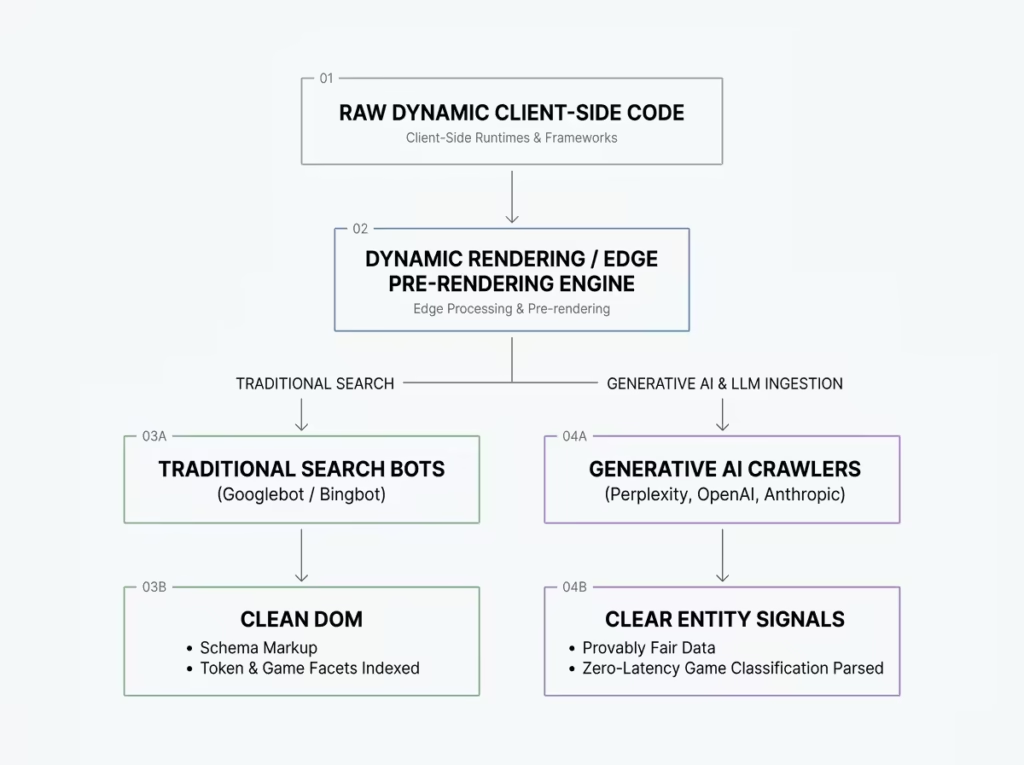
Crypto and Web3 casinos operate on single-page applications (SPAs), heavy JavaScript frameworks (React, Next.js, Vue), and dynamic WebSockets for live betting feeds. Without deliberate search architecture, search engine spiders encounter empty document object models (DOMs), leading to wasted crawl budgets and unindexed gaming lobbies.
Crawl Budget Maximization and Faceted Navigation
A large-scale crypto casino may house 5,000 to 10,000 game titles across crash games, live dealer rooms, slots, and on-chain prediction markets. If dynamic filtering (by software provider, volatility, RTP, or accepted cryptocurrency) is improperly configured, bots get trapped in infinite filter loops.
- Edge-Side Rendering (ESR) Implementation: We run headless pre-rendering at the CDN edge. Search crawlers receive clean, pre-rendered HTML containing all internal links, game descriptions, and real-time structured data, while human players enjoy seamless, low-latency client-side rendering.
- Canonicalization and URL Hygiene: Every multi-variable parameter must be strictly managed via canonical tags or controlled robots directives. Only high-intent search endpoints (e.g., /crypto-slots/high-volatility/ or /crash-games/bitcoin/) should be served as clean, indexable URLs, preventing parameter bloat from consuming platform crawl equity.
- XML Sitemaps Segmented by Game Velocity: Static evergreen titles (classic table games) and fast-evolving game formats (novel crash or live drop games) should live in separated, automatically updating sitemaps. This informs search bots exactly where new gaming software has been integrated without forcing a full-site recrawl.
2. Entity Salience and Generative Engine Optimization (GEO)
In 2026, ranking is no longer governed solely by keyword density; it is dictated by entity salience and knowledge graph integration. Generative engines do not read pages line by line; they extract structured entities, verify institutional authority, and synthesize answers for users seeking reliable platforms.
To position an on-chain gaming platform as a trusted authority, your technical agency must embed rich, machine-readable validation directly into the site’s code.
Deep Structured Data Architecture
Standard WebPage or Article schema is inadequate for decentralized gaming. We construct granular, multi-layered JSON-LD architectures that clearly communicate your platform’s operational parameters to search engine knowledge graphs:
JSON
{
“@context”: “https://schema.org”,
“@graph”: [
{
“@type”: “SoftwareApplication”,
“@id”: “https://brand.com/#application”,
“name”: “Platform Name Crash Engine”,
“applicationCategory”: “GameApplication”,
“operatingSystem”: “WebBrowser, iOS, Android”,
“offers”: {
“@type”: “Offer”,
“price”: “0”,
“priceCurrency”: “USD”
},
“featureList”: [
“Provably Fair Cryptographic Verification”,
“Instant Non-Custodial Wallet Connect”,
“Multi-Asset Settlement (BTC, ETH, USDT, SOL)”
]
},
{
“@type”: “WebSite”,
“@id”: “https://brand.com/#website”,
“url”: “https://brand.com/”,
“name”: “Platform Brand”,
“publisher”: {
“@type”: “Organization”,
“name”: “Platform Brand Global”,
“legalName”: “Platform Operator Ltd.”,
“knowsAbout”: [
“Smart Contract Casino Architecture”,
“Decentralized Wagering Protocols”,
“Provably Fair Random Number Generation”
]
}
}
]
}
By explicitly linking the site to verified technical domains—such as smart contract auditing registries, provably fair seed repositories, and recognized software suppliers—the platform establishes the entity trust necessary to be surfaced in AI answer engines when users ask for the safest, fastest-payout crypto casinos.
3. Intent Mapping: Transforming Searchers into First-Time Depositors (FTD)
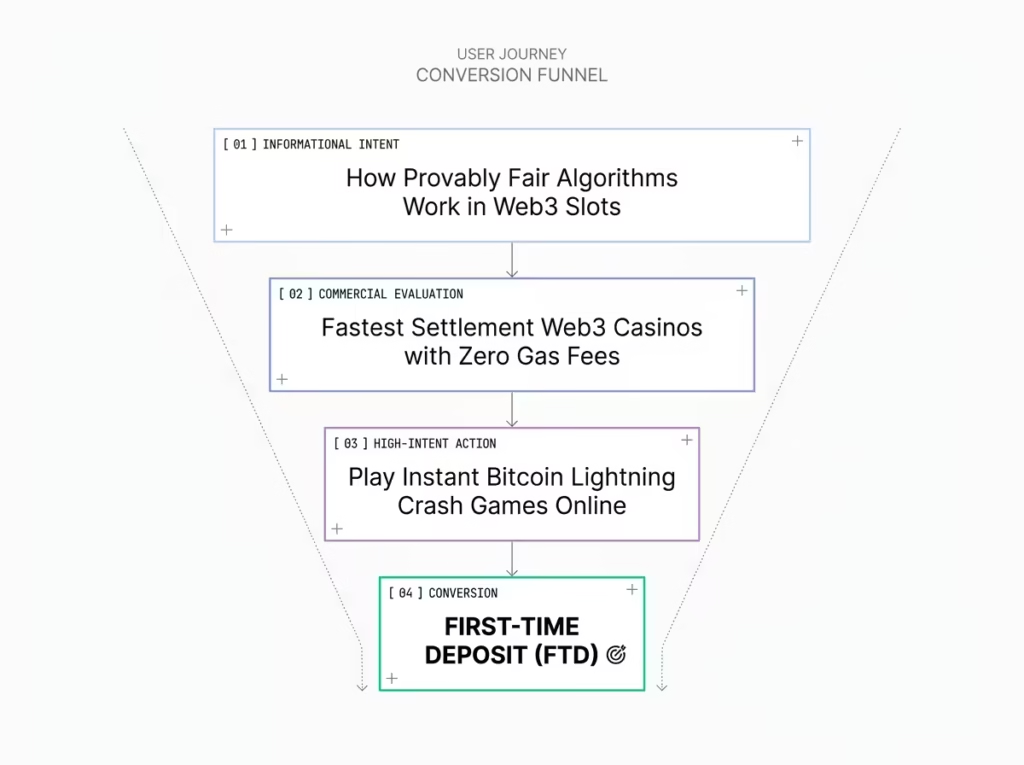
Generic SEO teams focus on vanity search volume, publishing low-value guides that attract bot traffic or unmonetizable visitors. An enterprise Web3 gaming acquisition strategy aligns content directly with the player lifecycle, deliberately transitioning visitors from informational awareness into verified deposits.
Strategic Intent Segmentation
- Top-of-Funnel (Awareness & Education): Target users diagnosing technical gaming concepts. Topics focus on algorithmic transparency, on-chain safety, and comparing non-custodial gaming versus traditional custodial models.
- Middle-of-Funnel (Platform Comparison): Capture high-intent crypto users comparing platform mechanics. Content focuses on transaction settlement speeds, network fee handling, accepted token ecosystems, and software provider comparisons (e.g., Pragmatic Play vs. Hacksaw crypto integrations).
- Bottom-of-Funnel (Direct Wagering & Action): Target direct transactional queries across specific game categories and token pairings (e.g., “instant-play Solana blackjack”). These landing pages prioritize fast load speeds, instant wallet-connect prompts, and immediate game lobby access.
To ensure this pipeline operates smoothly, platform operators must eliminate conversion bottlenecks between the content surface and the smart contract interface. For operators looking to systematically overhaul their organic acquisition, explore our specialized e-games SEO services to establish a high-converting search footprint.
4. Off-Page Authority: Navigating White-Hat Trust vs. Toxic PBN Traps
The online gaming sector has historically been overrun by Private Blog Networks (PBNs), link farms, and opaque backlink schemes. In modern search environments, search engines identify, devalue, and penalize unnatural link networks with remarkable precision.
A forward-thinking Web3 SEO strategy builds enterprise authority by acquiring backlinks through verifiable industry footprints:
- Auditing and Security Footprints: Publishing third-party smart contract audits, security penetration summaries, and reserve asset attestations naturally attracts organic citations from crypto analytics platforms, developer communities, and industry watchdogs.
- Software Provider Syndication: Securing co-marketing assets and verified partner mentions from tier-one gaming software providers and blockchain developer foundations establishes clean, topical authority.
- Data-Driven PR & Industry Research: Producing authoritative reports on crypto gaming volumes, tokenized wagering trends, and transaction velocity generates organic editorial coverage across mainstream financial and Web3 publications.
Actionable Playbook: Generalist Marketing vs. Specialized Web3 iGaming SEO
Evaluating an agency partner requires knowing how specialized execution differs from generic digital marketing deliverables:
| Operational Metric | Generalist SEO Agency | Specialized Web3 iGaming Agency |
| Primary KPI | Organic traffic impressions, broad keyword ranks | Verified First-Time Deposits (FTDs), Player LTV, Reduced Blended CPA |
| Technical Focus | Basic WordPress / CMS on-page optimization | Edge rendering, JavaScript DOM hydration, faceted lobby indexing |
| Entity Strategy | Generic meta tags and standard blog publishing | JSON-LD schema integration for crypto assets, games, and provably fair seeds |
| AI/AEO Optimization | Reactive, unformatted content writing | Structured entity optimization for zero-click AI platforms (Perplexity, AI Overviews) |
| Compliance & Routing | Ignores international gaming and jurisdictional nuances | Clean, geo-aware architecture that preserves crawl equity across target regions |
| Link Acquisition | Low-tier guest posting networks and generic directories | High-authority Web3 dev citations, audit platform profiles, tier-one software integrations |
5-Step Technical Audit Protocol for Crypto Casino Operators
Before deploying capital into extensive content or marketing campaigns, verify that your technical foundation meets modern enterprise benchmarks:
- Audit Bot-Rendered HTML: Run headless rendering tests across your top 20 game lobby pages to verify that game tiles, internal links, and category breadcrumbs are fully accessible in raw HTML without requiring user interactions.
- Eliminate Parameter Traps: Inspect server logs to ensure search bots are not spending crawl budget on endless combinations of game filters, search queries, and sorting parameters.
- Validate Structured Data: Use structured data testing suites to confirm your nested schema correctly establishes relationships between the operating entity, the gaming software, and provably fair protocols.
- Analyze Generative Brand Salience: Query leading generative answer engines with commercial buying queries in your game niche. Identify whether your platform is cited as a trusted provider or entirely absent from synthesized answers.
- Cleanse Backlink Risk: Identify legacy low-quality link packages or scraper sites pointing to your primary domain, ensuring link equity flows exclusively from contextually relevant gaming and Web3 domains.
Frequently Asked Questions
How does a Web3 SEO agency improve player acquisition costs for crypto casinos?
A specialized Web3 SEO agency builds compounding organic search channels that capture high-intent depositors without relying on high-cost paid ads or excessive affiliate revenue-share fees. By indexing targeted game lobbies and optimizing conversion funnels directly from search, operators steadily decrease their blended Cost Per Acquisition (CPA) while securing higher-retention players.
What is Generative Engine Optimization (GEO) in the context of online gaming?
Generative Engine Optimization (GEO) is the practice of structuring platform data, brand entities, and technical content so conversational AI engines (like Google AI Overviews and Perplexity) can parse, cite, and recommend your platform. In online gaming, this requires publishing verifiable data on provably fair mechanics, payout speeds, software certifications, and clear licensing credentials.
Why do standard JavaScript-based crypto casinos struggle to rank on Google?
Most crypto casinos rely heavily on single-page JavaScript frameworks that render games dynamically in the user’s browser. Search engine bots often do not execute client-side JavaScript immediately due to resource constraints, resulting in unindexed lobbies, missing internal links, and invisible game categories unless proper edge-rendering solutions are implemented.
How long does it take for a new crypto casino to see organic FTD growth?
With an enterprise technical audit, corrected rendering architecture, and targeted programmatic game lobby indexing, early indexing and ranking improvements typically emerge within 60 to 90 days. High-volume, compounding First-Time Deposits (FTDs) driven by high-intent transactional keywords generally scale significantly between months 4 and 6 as domain entity trust matures.
Scale Your Organic Player Pipeline
Operating a high-growth crypto casino or decentralized gaming platform demands an organic acquisition strategy engineered around technical compliance, dynamic site architectures, and generative search visibility. Generic marketing playbooks that rely on surface-level content will leave your lobbies empty and your ad budgets depleted.
At PplayEZ, we serve as the specialized white-label marketing and SEO engine for enterprise gaming operators, platform founders, and iGaming aggregators. We align technical performance directly with your commercial goals—scaling sustainable organic player acquisition, slashing blended CPAs, and protecting your margins.
Take the Next Step in Your Platform’s Organic Growth:
- Request a Growth Audit: Let our specialized gaming marketing strategists analyze your conversion pipeline and identify hidden drop-offs.
- or Email Us at hello@pplayez.com