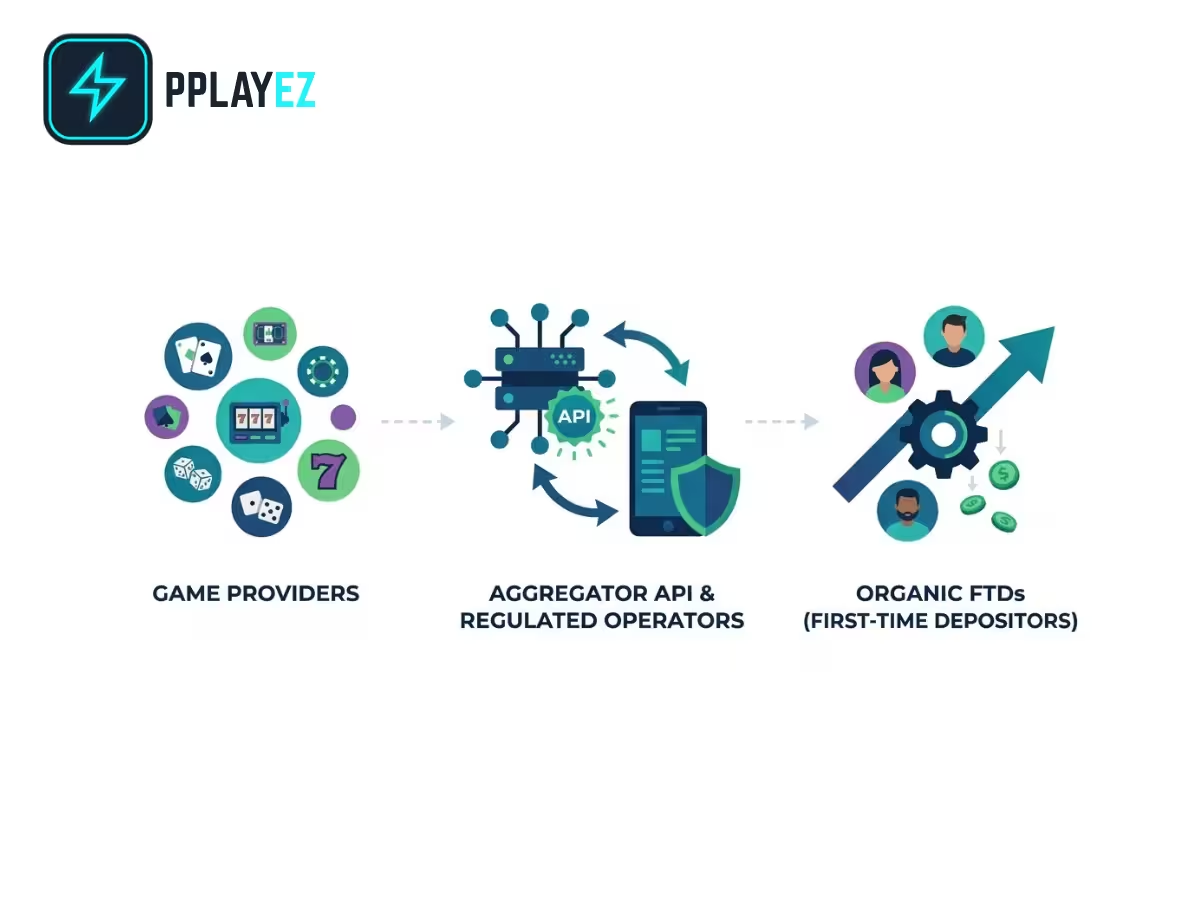
A slot games aggregator is a B2B middleware API that connects gaming operators to dozens of third-party slot studios through a single integration. In 2026, scaling an aggregator-powered platform in PAGCOR-regulated markets requires pairing certified studio governance with custom game-page indexing, server-side rendering, and Answer Engine Optimization (AEO) to eliminate duplicate content and capture organic player deposits.
In the Philippine and Southeast Asian e-games market, launching a lobby stocked with thousands of online slots is no longer a competitive advantage—it is baseline infrastructure. With paid social channels enforcing tighter gambling restrictions and paid search Customer Acquisition Costs (CAC) climbing across competitive terms, operators rely heavily on organic search and AI answer engines to sustain profitable First-Time Deposits (FTDs). Yet most operators deploy raw slot games aggregator feeds directly to production, inadvertently flooding their domains with identical studio descriptions, heavy iframes, and unindexable lobbies.
Turning an aggregated slot catalog into a compounding acquisition moat requires treating API game delivery as both a technical infrastructure discipline and a regulated search strategy. Without strict PAGCOR studio alignment, crawl-budget engineering, and localized conversion architecture, an expansive slot library actually dilutes domain authority rather than multiplying organic traffic. This guide breaks down the technical architecture, commercial execution models, content differentiation workflows, and vendor evaluation criteria required to scale aggregator-driven platforms in 2026.
The Commercial & Technical Bottleneck of Raw Slot Aggregation
A slot games aggregator streamlines B2B game distribution by consolidating commercial contracts, unified wallet APIs, and back-office reporting across studios like Pragmatic Play, PG Soft, JILI, and Hacksaw Gaming. While this middleware solves rapid game deployment for licensed operators, casino founders, and white-label agencies, it introduces severe commercial and algorithmic friction when left uncustomized.
1. Duplicate Metadata Across Competing Skins
Aggregator APIs push standardized game titles, thumbnail assets, and 40-word promotional blurbs to every connected operator simultaneously. When hundreds of regional domains publish identical text for the same flagship slot, search engines filter out redundant URLs under duplicate content suppression. As a result, new or mid-tier operators remain invisible on Page 4 while established portals capture all organic slot traffic.
2. PAGCOR Studio Certification & Geo-Fencing Risks
In the Philippine regulated e-games sector, offering a massive game count means nothing if uncertified titles leak into the public lobby. Operators must ensure that every game served through an aggregator originates from a PAGCOR-accredited provider with verified Random Number Generator (RNG) certification, paired with mandatory 21+ age gating. Serving unapproved studios or failing to enforce strict jurisdictional geo-fencing exposes the domain to regulatory sanctions and immediate disqualification from certified Google Ads programs.
3. JavaScript Lobby Bloat & Mobile Speed Penalties
Southeast Asian slot players predominantly access platforms on mid-range smartphones over variable 4G and 5G mobile connections. Out-of-the-box aggregator lobbies frequently load hundreds of uncompressed PNG thumbnails, synchronous studio scripts, and background WebSocket listeners on initial page load. Pushing Largest Contentful Paint (LCP) past 4.5 seconds causes mobile bounce rates to spike above 60% before a prospective depositor ever launches a demo spin.
4. Crawl Budget Exhaustion on Dynamic Filters
Many aggregator front-ends rely on client-side AJAX filtering or infinite scroll that hides individual slot URLs from search engine bots entirely. Conversely, poorly configured filter parameters (such as ?provider=all&volatility=high&page=34) generate tens of thousands of thin URL combinations. Search crawlers waste crawl budget parsing empty filter states instead of indexing high-converting game and provider hubs.
Architectural Blueprint: Engineering an Aggregator for Search & AI Visibility
At PplayEZ, our Triple E Ranking Strategy (Engineered, Executed, Elevated) establishes that technical precision filters out weak gaming platforms early. Before investing in external authority or paid media amplification, operators must re-engineer how their slot games aggregator renders, structures, and serves game data to both mobile players and AI crawlers.
1. Server-Side Rendering (SSR) & Clean URL Hierarchies
Public-facing game catalogs must render clean, crawlable HTML on initial request rather than relying solely on client-side JavaScript hydration. Operators should map each flagship game and studio hub to static, descriptive URLs (e.g., /slots/jili/super-ace/ and /slots/pg-soft/) while enforcing noindex, follow directives on dynamic lobby sorting parameters. This architecture ensures Googlebot and AI scrapers discover every commercial landing page cleanly.
2. Asset Optimization & Deferred Canvas Initialization
To hit sub-2.5-second LCP benchmarks on mobile networks, platforms must intercept raw studio artwork from the aggregator CDN and serve compressed WebP or AVIF thumbnails with explicit dimensions. Heavy HTML5 game containers and studio SDKs should remain strictly deferred until a user explicitly clicks “Play Real” or “Free Demo.” Isolating gameplay scripts preserves crisp mobile scrolling and boosts Core Web Vitals scores across the entire domain.
3. Game-Specific JSON-LD Schema & AIEO Readiness
Generative AI platforms—including Google AI Overviews, ChatGPT, and Perplexity—rely on explicit entity relationships when players ask where to play specific certified slots. Embedding nested JSON-LD schema (SoftwareApplication, Game, FAQPage, and Organization) explicitly binds each slot title to its certified developer, RTP specifications, mobile OS compatibility, and licensed operator credentials. Structured entity clarity turns individual slot pages into citable answers across conversational search engines.
4. Cashier Friction Reduction & Local Payment Trust Signals
Organic slot traffic fails to generate ROI if registration and deposit flows introduce payment ambiguity. High-converting aggregator wrappers integrate local Philippine payment rails—specifically GCash, Maya, QRPh, and instant local bank transfers—directly alongside game launch CTAs. Displaying transparent minimum deposit limits, verified SSL encryption badges, and rapid withdrawal windows reinforces both player trust and algorithmic quality signals.
5. Localized Lobby Prioritization & Multi-Market Routing
Operators serving both the Philippines and neighboring Southeast Asian markets must dynamically tailor aggregator lobby ordering to local player preferences. Implementing clean subfolder structures (/ph/, /th/, /vn/) with precise hreflang annotations allows platforms to surface locally dominant providers—such as JILI and Fa Chai in the Philippines—above the fold while isolating jurisdiction-specific PAGCOR compliance disclosures.
Content Differentiation & E-E-A-T for Aggregated Game Libraries
Once technical crawlability is established, operators must replace generic API game blurbs with authoritative, intent-mapped content that satisfies Google’s Your Money or Your Life (YMYL) quality thresholds.
1. Tiered Content Prioritization (The 80/20 Catalog Rule)
Writing 1,000-word reviews for 4,000 aggregated slots simultaneously is operationally inefficient. Instead, operators should audit search demand and studio popularity to segment their catalog into three tiers:
- Tier 1 (Top 100 Flagship Titles): Custom, long-form technical breakdowns featuring RTP analysis, volatility profiles, bonus mechanics, and interactive demo embeds.
- Tier 2 (Studio & Mechanic Hubs): Curated category hubs targeting high-volume commercial queries (e.g., “PAGCOR Certified PG Soft Slots” or “High-Volatility Scatter Games”).
- Tier 3 (Long-Tail Catalog): Clean, structured specification tables enriched with unique gameplay tips and automated internal cross-links to related Tier 1 titles.
2. Demonstrating Practitioner E-E-A-T
Anonymous, AI-spun game descriptions struggle to hold Page 1 positions in regulated gaming SERPs. Publishing detailed RTP guides, volatility explanations, and RNG fairness breakdowns under named gaming strategists—referencing documented frameworks from industry specialists like Fervil Von—demonstrates authentic Experience, Expertise, Authoritativeness, and Trustworthiness. Linking author bios to verified industry credentials and regulatory compliance pages builds durable algorithmic trust.
3. Strategic Ecosystem Partnerships & Authority Signals
Platforms powered by a slot games aggregator operate within an interconnected B2B ecosystem of game studios, payment gateways, and turnkey infrastructure providers like TapWhiteLabel. Auditing studio partner directories, press releases, and integration showcases uncovers high-value unlinked brand mentions that can be converted into contextual editorial backlinks. Co-publishing technical integration case studies or localized player trend reports with software partners generates authoritative niche citations without resorting to risky link schemes.
Is duplicate aggregator content keeping your slot catalog buried off Page 1? Uncover hidden crawl-budget traps, mobile speed bottlenecks, and missed organic FTD opportunities with PplayEZ’s Free 30-Minute E-Games Marketing Audit. Discover how our team transforms raw API game lobbies into high-converting search assets at PplayEZ SEO for E-Games.
Execution Models: In-House Team vs. White-Label / Specialized Agency
Scaling an aggregator-powered gaming brand requires rare cross-disciplinary execution spanning technical JavaScript SEO, PAGCOR regulatory compliance, iGaming copywriting, and white-hat digital PR. Operators and white-label agencies must weigh the operational trade-offs between building an internal department versus partnering with a specialized gaming growth team.
| Evaluation Dimension | Generalist Digital Agency | In-House Marketing Team | PplayEZ Specialized / White-Label Execution |
| PAGCOR & iGaming Compliance | High risk; unfamiliar with studio accreditation and 21+ ad policies | Moderate; requires ongoing legal training and compliance oversight | Built-in; every technical and content deliverable aligns with PAGCOR standards |
| Aggregator API & SPA SEO | Low; treats gaming lobbies like standard blogs or e-commerce stores | Slow; engineering bandwidth often bottlenecks SEO implementation | Battle-tested; proven SSR, schema, and crawl-budget frameworks for game APIs |
| Speed to Market | 3–4 months onboarding with steep industry learning curve | 4–6 months recruiting, training, and building outreach workflows | Immediate; turnkey deployment within 14–30 days via pre-built playbooks |
| Authority Link Acquisition | Relies on generic outreach or risky PBNs that trigger penalties | Expensive; requires dedicated PR headcount and studio relationships | Established network; direct access to vetted gaming, tech, and fintech publishers |
| Cost & Scalability | High retainer overhead with poor FTD attribution | Heavy fixed payroll, software stack, and management overhead | Predictable ROI; modular scaling across single brands or multi-skin portfolios |
Vendor & Platform Evaluation Criteria Before Scaling
Whether selecting a new slot games aggregator or auditing an existing platform for organic expansion, founders and marketing directors must verify five non-negotiable technical and compliance benchmarks:
- Granular Front-End DOM Control: Confirm the aggregator allows full customization of URL slugs, meta tags, H1 structures, and JSON-LD schema injection rather than locking game pages inside rigid, non-indexable vendor iframes.
- Studio-Level Geo-Fencing & Certification Logs: Verify the back office provides automated jurisdiction filtering and up-to-date RNG/PAGCOR accreditation certificates per studio to protect domain standing.
- CDN & Asset Compression Capabilities: Ensure game thumbnails and promotional banners can be served through edge caching in next-gen image formats without cross-origin latency penalties.
- Transparent RTP & Volatility Data Feeds: Confirm the API exposes structured game metadata (RTP percentages, hit frequency, min/max bet limits in PHP) so content teams can dynamically populate accurate comparison tables.
- Dedicated Technical Support SLAs: Prioritize aggregators and marketing partners that provide direct engineering Slack/Telegram channels to resolve API rendering or mobile UX bottlenecks rapidly.
Conclusion: Building a Sustainable Slot Games Aggregator Advantage
A slot games aggregator solves the operational challenge of delivering thousands of certified casino titles, but technical integration is only the starting line. In the 2026 Philippine and Southeast Asian e-games landscape, sustainable profitability belongs to operators who transform standardized API feeds into fast, PAGCOR-compliant, structurally unique acquisition ecosystems.
By combining server-side technical engineering, tiered YMYL game content, AIEO entity markup, and white-hat industry authority, operators escape the trap of duplicate lobby suppression and rising paid media costs. Whether scaling a direct-to-player licensed casino brand or managing multi-skin portfolios as a white-label partner, disciplined search and AI architecture turns your game catalog into a compounding FTD engine.
To explore how our specialists engineer compliant, high-ranking gaming platforms from the ground up, review our methodology at PplayEZ SEO for E-Games.
Frequently Asked Questions
Why do most online casinos fail to rank organically after integrating a slot games aggregator?
Most operators fail to rank because they publish default game descriptions and thumbnails pulled directly from the aggregator API, creating massive duplicate content across hundreds of competing sites. Additionally, heavy client-side JavaScript lobbies and unoptimized studio iframes degrade mobile Core Web Vitals and block search engine crawlers from indexing individual slot pages.
How can operators make aggregated slot pages unique without rewriting thousands of games manually?
Operators use a tiered prioritization strategy that pairs automated API data tables—displaying verified RTP, volatility, paylines, and PHP bet limits—with custom human-written reviews for their top 100 revenue-driving titles. Consolidating secondary titles under structured studio and mechanic hubs prevents thin content while capturing high-intent category searches.
What PAGCOR compliance standards affect slot games aggregator marketing in the Philippines?
Licensed Philippine e-games operators must ensure every game studio and RNG build delivered through an aggregator holds valid PAGCOR accreditation for local distribution. All game landing pages, promotional banners, and search ads must enforce strict 21+ age verification, display active license credentials, and include clear responsible gaming disclosures.
How does PplayEZ help gaming operators and white-label partners scale aggregator-powered platforms?
PplayEZ transforms raw aggregator sites into compliant, high-converting organic acquisition engines through our Triple E Ranking Strategy. We execute server-side crawl optimization, mobile speed engineering, YMYL-compliant slot content creation, AIEO/GEO entity schema, and white-hat authority link building for both direct operators and white-label agency partners.
Ready to Turn Your Slot Catalog Into a High-Converting Organic FTD Engine?
Stop letting duplicate aggregator feeds, slow mobile lobbies, and rising ad costs cap your platform’s growth. Partner with a specialized gaming growth team engineered for the technical, regulatory, and commercial realities of the Philippine and Southeast Asian e-games market.
- Book Your Free 30-Minute E-Games Marketing Audit: Receive a custom technical SEO, AEO visibility, and competitor gap roadmap tailored to your platform at PplayEZ.
- Connect Directly: Reach the PplayEZ team via WhatsApp or Viber for direct operator scaling or confidential white-label agency partnerships.